
Alzheimer's group sees success with art therapy programs
Featured on tulsaworld.com
Carol Morris dips a brush in the shiny dollop of bright blue paint and tentatively swabs it onto the sheet of clear plastic in front of her.
Her eyes narrow as she carefully sets the brush along the outline of the candy cane that has been traced onto the plastic, and paints a swath of blue.
It is obvious -? even to the casual observer -? that Morris is not greatly pleased with what she sees. But she loads her brush with more blue paint and applies another patch of color.
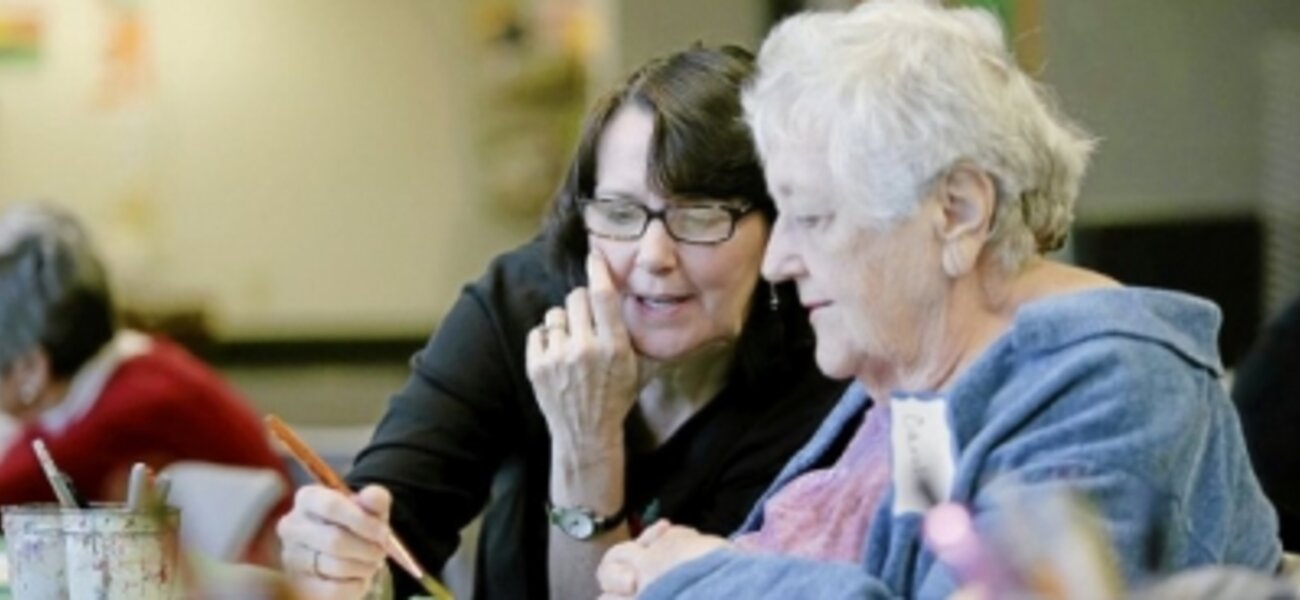
"Maybe you should use a different color for that section," said Sharon Goforth, indicating the small paper-plate palette that has circles of red, white, green and yellow paint, as well as blue.
Morris starts to dip her blue-saturated brush into the glob of green, but Goforth suggests that red would be a better choice.
"That way, you'd have purple," she said.
True enough, but this change still doesn't sit well with Morris. Finally, she pushes her half-completed painting aside.
"I don't want to do this today," Morris said. She looks down at the image of the candy cane, and said, "This looks like a snake to me. And I don't like snakes."
So Morris watches, closely, as Goforth helps finish the painting. And when Goforth holds up the painting, so that the light from the window streams through it, as if it were made of stained glass, Morris acknowledges the effort and the results with a small smile and a satisfied nod.
Morris is one of nine people, each of them living with some degree of Alzheimer's disease, who are taking part this Tuesday morning in a program offered through the Oklahoma chapter of the Alzheimer's Association in cooperation with local arts organizations.
"It's inspired by a program called Drawing on Memories, that the Museum of Modern Art in New York started years ago," said Ronda Roberts, programs manager for the Alzheimer's Association in Tulsa. "We try to provide them with a complete artistic experience, from learning about a specific piece of art to creating something of their own."
The program provides a number of potential benefits, Roberts said.
"It can give those who might not be able to communicate verbally a way to connect with others," she said. "It can really elevate some people's mood, to be in a friendly environment, to be able to focus on making something.
"And it often can help spark a memory of good times in that individual's past," Roberts said.
Click here to read the full article.